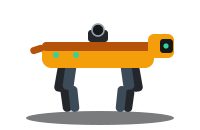
Mini Pupper
A robot dog you build yourself: MangDang's open-source quadruped packs 12 servos and a Raspberry Pi into 560 g, and the whole design — CAD, code, docs — is published. The Robodex's smallest dog by far.
Spec
| Battery | 800 mAh, 2S — 7.4 V nominal; MangDang's docs warn that over 8.4 V (over 2S) will fry the servos |
|---|---|
| Computer | Raspberry Pi |
| Dimensions | 209 × 109 × 165 mm (MangDang published specification) |
| Servos | 12 custom servos, 3 per leg (12 DOF) |
| Structure mass note | The published URDF's link masses sum to just 0.304 kg — structure only; the servos, Pi and battery that make up the rest of the 560 g are not in the model |
| Weight | 560 g (MangDang published specification) |
examples/mini-pupper.jsonDimensions, weight, battery capacity and servo count from MangDang's published specifications (launch specification, as also reported by CNX Software and the Raspberry Pi magazine). The 2S / 7.4 V battery figure is from MangDang's own documentation ('battery spec… voltage should be less than 7.4 V'; over 8.4 V 'you'll almost certainly fry all your servos'). The description package's link masses (0.304 kg, structure only) are recorded in the key specs, not passed off as the robot's weight. No official v1 photo is linkable — the repository's photo shows the v2 — so this entry carries a labeled RobotForge line illustration instead.Gate runs
The motion gate covers ground robots today. This class has no gate yet, so there is no verdict to show — the note below says why, in the entry's own words.
No recorded gate runs yet. This robot has no verdict until one is measured.
Static stability check
A computation from this robot's spec — support-polygon statics, not a simulation run and not a gate verdict. It grades how far the robot can tip before its centre of mass passes over its feet. The gate status above is unchanged by it: this robot is still not gated.
| Grade | STABLE |
|---|---|
| Static tip-over angle (weakest direction) | 27.9° — to the right |
| Weakest tip margin | 48 mm from the centre-of-mass projection to the support-polygon edge |
| Margin as share of the body's half-extent | 88% |
| Centre-of-mass height | 0.091 m — ASSUMED at 55% of standing height (printed in the report's assumptions, never buried) |
| Thresholds (v1, printed on the report) | tip angle ≥ 20° STABLE · 10–20° MARGINAL · < 10° UNSTABLE |
Report: catalog/stability-reports/mini-pupper.json · checked 2026-10-26 · reproduce with robotforge stability examples/mini-pupper.json
How it was computed
Support-polygon statics from the spec's declared dimensions: convex hull of the foot contacts, weakest-direction distance from the centre-of-mass projection to a polygon edge, tip-over angle atan(margin / CoM height). No simulation, no motion — a computation, not a gate run.
Support model: Four point feet in static stance, placed from the body length/width with the take-apart viewer's fractions (x = ±0.405 × length, y = ±0.44 × width).
| Direction | Margin | Tip angle |
|---|---|---|
| to the right | 48 mm | 27.9° |
| forward | 85 mm | 43.0° |
| to the left | 48 mm | 27.9° |
| backward | 85 mm | 43.0° |
Assumptions (all of them, as printed in the report):
- Feet are points at the viewer's stance placement; the spec publishes no foot-placement dimensions.
- All four feet are on the ground (static stance, no gait).
- Centre of mass sits horizontally at the centre of the body footprint.
- CoM height is ASSUMED at 55% of standing height — the spec declares no CoM height.
- Flat, level ground; rigid body; no payload.
Harness checks
Electrical computations over this robot's documented wiring graph — voltage drop, ampacity, logic levels, rail budgets, connector matching. Not a gate run and not a simulation: each check is Checked, Partial or Not checked, and the headline is counts, never a blanket pass.
0 checked clean · 0 with warnings · 0 with errors · 0 partial · 8 not checked · missing data: current_a for motors ×5, cable.gauge_awg ×4, cable.length_mm ×2
| Check | Checked | Partial | Not checked |
|---|---|---|---|
| voltage drop | 0 | 0 | 2 |
| ampacity | 0 | 0 | 2 |
| logic levels | 0 | 0 | 0 |
| rail budget | 0 | 0 | 2 |
| connector match | 0 | 0 | 2 |
Findings: none — the inputs that could be checked raised nothing. That is not the same as everything being checked; the counts above say how much was.
Missing data — the datasheets still to hunt. A check that could not run says what it needs:
| Missing input | Blocks | Needed by |
|---|---|---|
current_a for motors | 5 | battery -> board, board -> motors, board rail |
cable.gauge_awg | 4 | battery -> board, board -> motors |
cable.length_mm | 2 | battery -> board, board -> motors |
connector at both ends (connector_from / connector_to) | 2 | battery -> board, board -> motors |
connection voltage (volts) | 1 | board -> motors |
current_a for board | 1 | battery rail |
rated output current for battery | 1 | battery rail |
rated output current for board | 1 | board rail |
Report: catalog/harness-reports/mini-pupper.json · checked 2026-10-26 · reproduce with robotforge harness examples/mini-pupper.json
Take it apart
This viewer derives a schematic take-apart straight from the spec's numbers — the same one-derivation rule as the ground kits — flat views, or in 3D with the toggle. It is a schematic of the real robot's layout, not a printable kit: robotforge cad kits cover ground robots only today. Click any part.
examples/mini-pupper.json…Reproduce it
Run these from a clone of the repository. The twin, CAD kit and motion gate (urdf / cad / run-gate) cover ground robots today, so they are not listed here.
robotforge validate examples/mini-pupper.json
robotforge stability examples/mini-pupper.json
robotforge catalog robot 8
robotforge harness examples/mini-pupper.json